Offer ends in Offer $99 for 1 year 7daysd 08 45 41 One year for $99 Get your year
Tango Topics info:

Check out the Tango Dictionary for words like Axis and Connection.

Tag: argentine cross

  • Crossing Sacada Turn

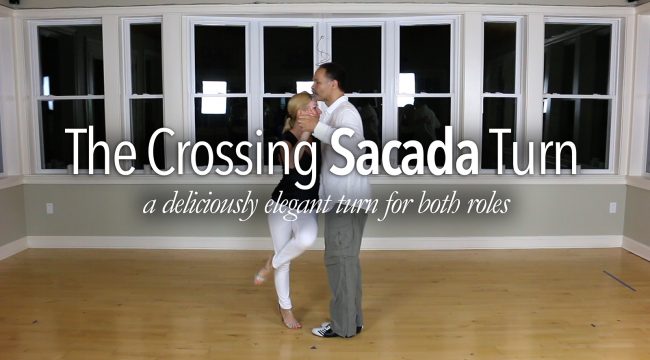
    Crossing Sacada Turn

    What is a Crossing Sacada Turn ? In its simplest form, it’s nothing more than a series of Simple Sacadas that are chained together that just so happen to utilize the Follower’s Molinete or ‘Turn’, which employs the Argentine Cross as it’s basis for entry. While the turn can be done without this entry point, it loses it’s ‘elegance’ by without using the Argentine Cross.

    To be clear, a ‘Sacada’ is one of 4 types of Tango Displacements (Boleos, Gancho, Wrap/Enganche, and Sacadas), meaning that either the dancer’s leg will displace or their entire body will be displaced or take the place of their partner. A Sacada can be done from open or close embrace, it can be done by either role to the other, and has lots and lots and lots of options (about 501, at last count – not kidding).

    A turn, as defined by Tango Topics, can be but is not limited to these ideas in order of precedence: 1.) The Follower’s Molinete to the Lead’s Giro (the Common ‘Turn’). 2.) A Milonguero Turn. 3.) The Ocho Cortado. 4.) The Argentine Rock Step/Turn. 5.) The Calecita. 6.) A Walking Turn.  7.) The Media Luna. and 8.) A Single Axis Turn.

    A ‘Crossing’ Sacada Turn ? Is exactly what it sounds like, a turn that has a bunch of Sacadas as part of it. In this particular case, this Sacada Turn uses the Follower’s Molinete, and a very important structure that Tango Topics completely eschews repeatedly, and says that you should never, ever do. This is the ONE time when you do want to do that, however with all things, there’s always a caveat to the caveat. That said, let’s talk about The Crossing Sacada Turn.

    The Free Tip. Something to keep in the back of your mind is that while this is a cool piece of vocabulary and you’ll see it executed a lot, there is another version of this that does NOT include the last Sacada. Truthfully we can execute the Sacada Turn without the 3rd Sacada, and everything works just fine, sort of. Doing so, can generate other options and opportunities for us as Leads and Followers. However, one thing that will continually plague you is why the Follower continually turns away from the Lead after the 2nd or 3rd Sacada! There’s a reason for that, and there’s also a solution for it which is why it is important that you watch the video in it’s entirety to see exactly what is generating proper execution of the Sacada Turn! And don’t just rely on your eyes to assume what’s happening here.

    About The Video. This video comes in at 34m:02s in length in 13 Sections. This video contains no Follower and/or and very little Lead Technique.

    Section 1 – Introduction – 00:00:52
    Section 2 – Argentine Cross – The Starting Point – 00:01:32
    Section 3 – The Lead’s Cross Behind – 00:02:35
    Section 4 – The First Sacada – 00:01:09
    Section 5 – The Follower’s Flailing Foot Error – 00:02:17
    Section 6 – The Second Sacada – 00:01:32
    Section 7 – The Third Sacada – 00:03:10
    Section 8 – The First Complete Sacada Turn – 00:01:32
    Section 9 – The Turning Brake – 00:04:08 (technique)
    Section 10 – Removing The 3rd Sacada – 00:00:58
    Section 11 – A Variation On A Theme – 00:03:47
    Section 12 – The Close Embrace Version – 00:01:34

    Section 13 – With A Metronome/Closure – 00:02:34

  • The Cross – Getting In Front

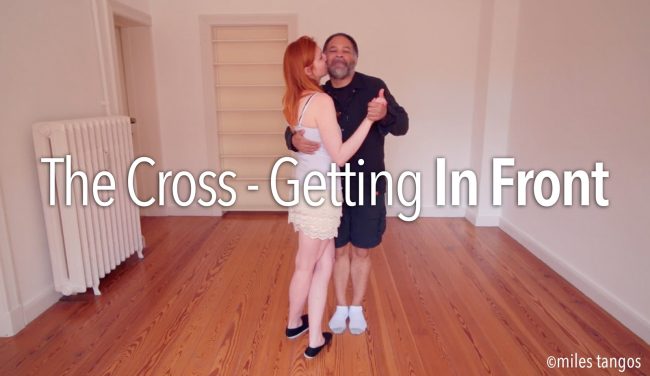
    The Cross – Getting In Front

    For most Followers, that haven’t been properly trained, they are rushed into an Argentine Cross right from the start of their Tango dancing lives. Aside from Ochos, it’s the one thing that they’re pressed to do without any training aside from the Lead/er (Controlling Lead hence the ‘/er’ part) that quite literally tells them what to do as they’re doing it. From that moment, right up until this one (assuming you’ve shared this video with them) they more than likely have no idea a.) why they’re crossing their feet. and b.) more importantly what the point of the Cross is, and c.) what it all means.

    The Problem: This isn’t so much a Lead problem as it is a Follower issue. Contrary to what you might have been told, the Argentine Cross does actually serve a function. And believe it or not, it’s not to do a Cross every 15 seconds for no good goddamned reason. No. The function of the cross…is well, you can watch the video for that part. The problem is that not only is the Follower not aware of what the function of the Cross is, they’ve been so indoctrinated into a passive way of dancing that they’ll a.) Willy-nilly cross their feet due Two of the Five Errors of The Cross – specifically the Automagical Cross and the Wimpy Cross (see below), where in the case of the latter, the Follower has to infer what on god’s green earth the Lead is attempting to do. (In the other 3 cases they don’t have to infer, they’re quite literally forced into crossing their feet whether they wanted to or not). and b.) That a good portion of the time, the Follower will end up in the Lead’s Arm Pit. It is for this reason that we talk about – Getting In Front of Your Lead!

    video
    play-rounded-fill

    From a Following Perspective, 10% of this problem is your issue. And it has to do with you understanding that the Cross is actually, in modern Tango, your piece of vocabulary. Not the Lead’s, it’s yours! There are many people that will disagree with this statement that the Cross is the Follower’s vocabulary. The fact is that without you cooperating, the Argentine Cross, is not going to happen. You could say this about almost everything else in Tango, that without you cooperating nothing happens. And you’d be right. However in this instance, this is one of the few places where the Follower has an enormous amount of control of when something is done, how something is done, and most importantly where we go next! All of that from you crossing your feet. In this instance, this one little piece of vocabulary is YOUR place for you to shine, to sparkle, to show off your skillz as a Follower. Instead, what happens ? Well…watch the video.

    To be fair, you have to contend with the Five Errors of the Cross (see above), and then there’s the squeezing, the pushing, the pulling from your Leads. And then there are your issues, while in heels, to contend with. That aside, you do have an issue which is solely yours, which is the whole point of this topic – to get back in front of your lead!

    The simple fact is that your lead (the action, not the person – lowercase ‘l’) either stepped outside partner or stepped into cross system and in either case you’re essentially out of step with them. The whole point of the cross is to get back in front of your Lead (the person).  However, part of your issue is that you’ve been indoctrinated to a way of moving that quite factually doesn’t work for you. The way that you’re moving is to send your leg straight back, and really to cross your body meridian away from the couple. This creates a problem for you, especially when you come to collect your feet in the cross. Your feet look like two mismatched and broken sticks pointing in opposite directions from each other with a watermelon in between them, instead of what they can look like. We do want pretty feet, but we don’t want pretty knees, when we come to collection and even crossed collection! However, there’s a tiny little problem in that your body is in the wrong place, and your hips are all twisted and you’re basically out of alignment with your Lead, and on top of all of that, you’re stuck in the Lead’s arm pit! And there you will stay…sadly. 🙁 Unless…you do something about it. 🙂

    From a Leading Perspective, before we launch into Follower’s side of this. Let’s give credit for this problem, where credit is due. The Lead! Dude, a good 90% of this problem is your fault. Let’s be clear about responsibility here. You created this problem and the Follower is only doing their best trying to fix it. How did this become your problem ? 1.) You lined up with the Follower in your Arm Pit! You placed them in there right from the gitgo (‘start‘ for the non-native english speakers), and what’s worse is that you kept them there, holding them in that spot, because it was convenient for you to pull off some crazy vocabulary, which you think you need to lead every 20 seconds, instead of (gasp!) actually walking with your Follower to the music. Eeeek! Which for some reason is ‘boring’ to you but heaven to them…gosh I wonder why !?!?!?  2.) Your embrace that you think is comfortable is like laying on a bed of nails because it’s too compressive! Think ‘squeeze‘ and you’ll get the right idea. And even if someone tells you that to lighten up and let them loose, you’ll go right back to squeezing the daylights out of your partners because to you think, a.) this is comfortable. and b.) it’s all you know. 3.) Because your right arm is like a vice grip and you have this rather nasty tendency to paddle your Follower’s with your right hand to ‘direct’ them, you somehow believe that this is desirable. Ummmmm not! And lastly you created this problem by 4.) being too damned restrictive and not being responsible by continually placing the Follower in front of you by repositioning your vocabulary to do just that. Instead, doing all 3 previous things to show off to keep the Follower from realizing that you were completely ignorant about 3 steps in and don’t have a plan for the rest of the song let alone for the tanda! Yup, your fault.

    The Dancing Reality is that this stuff happens with such frequency that no one, not even the teachers that you’re studying with pay it any mind. It’s so commonplace that one wonders if anyone is actually teaching technique to specifically create this issue! “Leads! You place the follower in your armpit, and then rush around the room, all the while pulling and pushing! Followers, your whole job here is to stay in the Lead’s armpit and then to come to a crossed collection so that your hips are all twisted up and you’re off to the side of your lead! Ready ? Go!”. Not!

  • The Argentine ‘Dip’

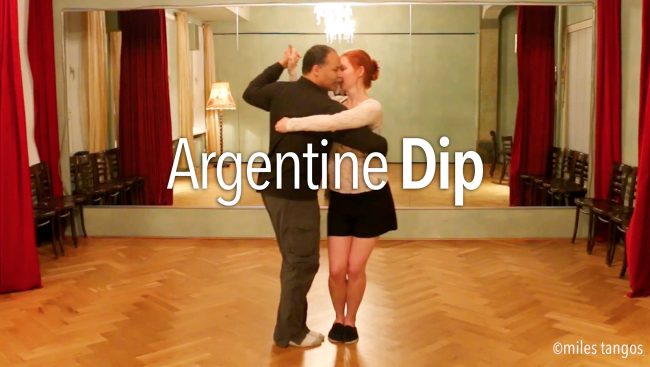
    The Argentine ‘Dip’

    The ‘Dip’ is a very common form and expressive move used in most social dances. Argentine Tango has it’s own version of a ‘Dip’, however this version of the Dip looks nothing like what you’ve seen before. It’s almost not worth calling it a ‘Dip’ to begin with but it is in truth of fact, the Argentine version does classify as a ‘Dip’.

    Let’s back up a moment and address the possibility that you have no idea what a ‘Dip’ is. A ’Dip’ refers to what is called a Dancing Dip. And it is what it sounds like, a physiological dip in the movement of the couple. Where one partner, the Lead, stops the dance for a moment to express some aspect in the music. Usually that moment is characterized by a long, languid note.  At that point the other partner (the Follower in this case) is led into a controlled, but partial, fall within the embrace of the first partner (the Lead). This is a ‘Dip’ in technical terms. Usually this kind of move is very, very dramatic, and done in the extreme to maximize it’s effect. And the effect is very visual, generating lots and lots visual lines, postures, and poses for the couple. One such idea is the ‘Death Drop Dip’ (which Tango does use in Performance Tango) where the Follower is led to almost touching the ground with their back, and one arm stretched out towards their partner  The Argentine Social Dance version of this idea is the polar opposite of this extreme idea. The Argentine Dip is more felt than it is dip. That said, let’s talk about the Argentine Dip.

    What is an Argentine ‘Dip’ ? Every dance has a form of a ‘dip’ where the Follower is being led to, quite literally, dip their body either forwards or most commonly backward. You’ll see this idea represented in dancing movies from the 1930’s and 40’s, look at the clip below which starts at 01:29, and then wait for it at 01:35! That is a classic dip, more a drop than a dip. But this is the classic dip.

    video
    play-rounded-fill

    Tango has its version of this idea, only it’s not so dramatic, not even close. As a matter of fact you’ve been doing them all along and haven’t even realized it! That’s because the dip is embedded in a very specific piece of tango vocabulary: The Argentine Cross.

    Let’s not make a mountain out of a Mole hill here, after the Follower is led (this part is very important > ‘the follower is led‘, not implied, which frequently happens) to cross their feet in a Normal Cross (See > 256 Argentine Cross Variations) the Argentine Dip can occur at this juncture because it’s an elongated forward step out of the Argentine Cross! There is, however, a catch with this thing. There’s always a catch. And the devil in this case is in the details. And the detail is what specifically is generating the impulse to ‘dip’.

    Aside from the devil in the detail, there’s something else you should know. This isn’t a ‘dip’ per se, not in the traditional sense. Truthfully, it’s a misnomer in terms. It’s more of a ‘hang’ for a long moment more than anything else. It’s not a ‘dip’ as in the sense of the Fred Astaire/Ginger Rogers dip above. It’s not that by any stretch of the imagination. It is however a very, very, very long hang. And even that’s a misnomer, but it’s the closest thing that we can reference that makes any sort of sense.

    The Free Tip. The Argentine Dip does require both parties to aware of what’s going on at all times. This isn’t a situation where you lead and they follow. No. It’s a situational awareness and needs to be trained into the dancer to show exactly what this feels like. The video above is a good start. And the reason is that very few teachers actually show this stuff, let alone talk about it.

    About The Video. This video is 13:14 in length in 5 Sections. Both Lead and Follow technique is co-combined. 

    Introduction/Overview – 03:04
    Engaging Over-Rotation – 03:06
    Close Embrace Details – 01:06
    The ‘Hang’ – 02:45
    Follower Adornments & Embellishments – 01:18

  • The Expectant Cross

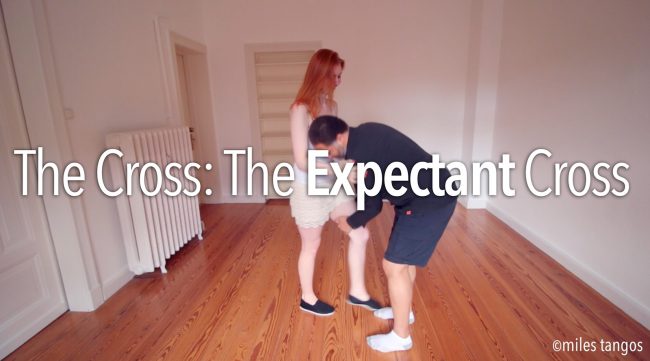
    The Expectant Cross

    For most Lead/ers (and Leads) we lead the Argentine Cross so often that we stop thinking about actually leading it and it just sort of ‘happens’. The reason it just happens is because of it’s ubiquitousness, its frequency. You do this enough times and even the most battle hardened Follower will cross their feet just to shut you up so that you’ll stop asking for the damned thing! 

    The Problem: This is clearly a Lead/er (and Lead) issue. Contrary to what you may have been told the Argentine Cross is not two steps outside partner and the Follower automagically crosses their feet. If that were true then walking on 3 tracks would never happen. No the problem is the fact that we, as Leads, are expectant that we go to the cross, and then the cross just magically happens. We walk, they cross. Viola! Moving on to other things. Not! No. Not ‘moving on to other things’. The problem here is that you, as a a lead, are entirely expectant of the Follower crossing their feet every 20 steps.

    From a Following Perspective, 10% of this problem is your issue, the other 90% is your Lead. The fact is that you should adhere to one singular rule at all times (as a Passive Follow, not as an Active Follow — not yet at least). The rule (again as a Passive Follow – this rule doesn’t apply to the Active Follow) ? If you don’t feel it, you don’t go there. It’s a pretty simple rule really. If it’s not led, then you don’t go there. More clearly – if you’re not aware of what your Lead is proposing, suggesting, inviting, engaging, while they’re attempting to being insanely clear about what they’re leading – minus the arm pulling, tension, resistance, forcing, pushing, and pulling that generally passes for leading at most milongas….assuming there is none of that business going on, then there’s only one thing left: If you didn’t feel it, then there’s absolutely no reason for you to do anything. Period. No lead ? Then listen (note the language there….’listen‘ not wait….’listen‘ for what’s going on). Do not give the Lead a Cross, simply because they stepped outside partner and took two steps. Unless, and there is always an unless, one of two conditions has been met. Condition 1.) They’ve actually generated the proper conditions for an argentine cross to exist. or 2.) It’s at a Milonga. If it’s at a Class, a Practica, a Guided Practica, a Workshop, or a Seminar, then don’t cross your feet unless led to do so. Assuming what’s already been discussed. Every time that you do give a Lead a Cross, it reinforces the belief that they’ve led things in a desirable manner that is conducive to dancing. And every time that you don’t, you force the lead to … well … actually guide, invite, suggest, cajole, propose, intend,… ummm lead a cross! Mind you a discussion might ensue of why you’re not crossing your feet. Which may involve a teacher or two getting a teacher to discuss the matter. But that’s what they are there for anyway. 😉 

    At the same time, because we’ve broached the subject of the Role of the Active Follower, you do have a golden opportunity here because your lead isn’t clear, they’re not necessarily paying attention to what they’re leading at this point, this is an opportunity for you to interject an idea or two. More important to our point: To take a modicum of control and quite literally, if not factually, redirect the next step! I know…HERESY! Absolute Heresy! How dare I advocate a Follower interjecting an idea of their own….eeeek!

    Believe it or not, you can slow the Lead down at this point to accentuate what’s happening in the music, you can speed it up, you can even control what step will happen next, and more importantly where you want to go! That’s a part of being an Active Following, we want to start to engage with what’s going on! That’s why the language above is LISTEN and not WAIT! 

    However, as an Active (not Passive) Follow, there are 2 rules that we have to adhere to as Followers in this instance: 1.) If it’s not in the music, then it’s not on the floor! 2.) If you’re going to redirect the lead, then you have to have an exit strategy for where you’re going next and more importantly how to get out of things! In other words – a plan! To be fair it is important to recognize that a good portion of Leads freak right out when you ‘screw up‘ (which is really their fault to begin with because they weren’t clear) and then you take responsibility for by saying “sorry“.  One can only imagine if you interject an idea or two and watch what happens then. Talk about losing your proverbial mind! Good lord. So a.) Pick your Leads very carefully with this ‘active’ Following business, and b.) whatever you do, it’s got to be musically driven!

    While this post is not on the Role of the Active Follower per se, it does touch on it considerably because the cross is all about the role of the active Follower for a variety of reasons most notably because the Cross is the Follower’s vocabulary, not the Lead’s. That said it should be noted that as a Follower, this whole Active Follower business is a little scary at first but once you open the door way to that happening….really cool things can occur! Cool and wonderful things actually. 

    From a Leading Perspective, 90% of the reason why the Follower does not cross their feet is really your issue. Let’s call a spade, a spade: You expect a cross to just ‘magically‘ happen. The fact is that a good 99% of your crosses aren’t led in any way, shape, or form. You step into a parallel system cross (not exactly the most elegant crossing structure in the world, it screams ‘beginner lead’ ) and then take 2 steps, and the Follower just ‘crosses’ because they’re supposed to. Right ? There’s no question in your mind, or theirs. Right ? The problem is that is the problem! You’re not actually leading. You’re abdicating control of options and opportunities for both roles at this point. Every time that you expect a cross to magically happen, you create the situation for the Follower to actually take control and choose what’s going to happen next, whether or not you or they are aware of it. Mind you a good portion of Followers don’t do this, and they should because it opens options and opportunities for us to make other choices. At the beginning those choices are haphazard and untried and you’re going to stumble a bit. But in the end your versatility goes right through the proverbial roof! And we want our versatility to do precisely that! 

    We want to encourage an active participation behavior from our Followers because it makes them feel as though they have a voice in the dance. Why ? Answer – Imagine someone dictating to you what you should do all day long. Every hour of every day. You have a mind of your own, and you do like to solve problems your own way. You don’t like to be told what to do or what to think. But that’s exactly what you’re telling your Follower to do each and every time you dance with them. “Don’t think. Don’t move, unless I say so. Don’t have an idea! That’s my job!”. How boring is that ? Ideally you want them to be a co-creating partner in the dance. Not just a vocabulary plaything. Which is precisely what they are now. By going at things in a slightly different way,  you open the doorway to a far more satisfying and co-creating dancing experience than anything else! Don’t mishear this as ‘Passive’ dancing is bad (which is what happens a good portion of the time), it isn’t fun and Miles said….not! Some people like that. They like turning off their ability to chose and would rather let someone else do the driving. But then … (there’s always a ‘then’) a piece of music comes on that they really like and well…they get involved and would like to make a few choices on their own. But unfortunately they’re with a Lead who just doesn’t allow for this stuff. And it feels kind of limiting. And once they’ve gotten used to making a few choices, they’ll want to do more of it and make it a regular part of their dance to interpret those musical ideas they’re having in their head.

    Put another way, ideally we want to create ‘space’ for the Follower to have a choice in what they’re being asked to do. Doing so generates a sensation of comfort that you’re allowing the freedom to choose, which in turn generates an investment in what they’re doing and more importantly how they’re doing it. All this from an Argentine Cross! 

    The Dancing Reality is that no matter what’s written here, no matter what I say as a teacher, you’re not going to change what you’re doing. You’re going to keep doing what you do because you a.) don’t know any better. and b.) It’s comfortable. c.) Change is hard. d.) All this business of the Active Follower is absolute crap (unless you’re the Follower in which case, they completely get it). 

    Thought is hard. Better…yes…better is hard. So who wants to do all that work to be better when it’s so much easier to just to continue doing the same things over and over again! The reality is that you would rather continue down the pathway that you’re on than to change what you’re doing. The reality is that you like the automagical cross. It just makes things soooo much easier for both partners and really the whole floor if the Follower just crosses their damned feet. It means that as a Lead, you don’t have to think so much.  And as a Follower we can have about 10 seconds of what is essentially 2 and a half minutes of pushing and pulling, of peace.  That’s the reality. 

    Fixing it ? Well, there’s a really simple solution, it’s something that both lead and follower must do. Hmmmm, however as a FREE user, you’re not able to see the full solution, you have to upgrade to either a Silver, Gold, or Diamond level user! Once you do that you’ll be able to see this solution to this problem as well as over 100+ videos on tango technique, codigos, and more.

Hide picture